Monday, November 22, 2010
Save the Words
You don't normally think of the Oxford English Dictionary people as silly, but they've developed a project that's pretty goofy, and it's something you can do with your kid to get her thinking about language.
They've rounded up hundreds of words that don't get used much any more. Words like gumfiate (to swell), lambition (licking) and vellicle (something that pinches or holds fast).
They've taken all of these nearly extinct words and knitted them into a virtual quilt, which you'll find here.
When you move your mouse over the words, they'll call out to you: "Pick me! Pick me!" They want you to adopt them.
You can find a word or two that you like and click on them. That will bring up its definition, and a form that allows you to "adopt" it. (Like all adoptions, you first have to register. Unlike human adoptions, it's free.)
Adopting a word means pledging that you'll try to bring it back into the mainstream. You'll use it in conversation and in writing, and you'll explain it to people.
Save a Word is meant to be a fun concept to get people thinking about words. It's a great resource to use to talk to your child about the fact that words evolve and how our language has changed.
Friday, October 29, 2010
Winner of PictureIt Contest
We have a winner! We put all of the names in a (virtual) hat and randomly chose a winner. Congratulations to Maria Butcher, who should be receiving the books right... about... now.
Maria mentioned in her comment that her son has Asperger's - these books, in which the child draws his own illustrations, may be an excellent resource for him. I hope Maria will let us know if he enjoys the books (or not - either way, we wanna know!).
Now, for all of you who entered but didn't win
I can't bear to see anyone walk away empty-handed! So I went back to PictureIt and asked if they could offer some small discount to anyone who entered but didn't win.
They're not set up to offer discounts, but here's what they generously offered to do: If you entered the contest, they will give you free shipping if you purchase the books through their website directly.
So if you entered the contest and want to buy the books and take advantage of this offer, you'll need to e-mail Alicia and Leanne (the creators) directly and mention Getting Kids Reading. They can be reached at creators at pictureitpicturebooks dot com.
Thank you to PictureIt for supplying the six free books. And congratulations on having recently been picked up by Chapters/Indigo!
If you don't know what I'm talking about, here are the links to our contest (which, as I say, is now over). Thanks everyone!
PictureIt book giveaway
Win free PictureIt books
Thursday, October 28, 2010
Mother-Son bookclub part II
It’s a great example of parents taking their children’s literacy into their own hands. And anyone can do it – you can do it.
| The boys drew, read, wrote, ate, chatted, answered quiz questions and had an amazing time. |
There were about half a dozen moms wondering what the heck was going on. (The one dad remained very calm, taking it all in stride.) The moms all had the same expression on our faces. It said: “This is chaos!”
Yes, it was chaos. It was wonderful chaos.
It was the way boys often need to learn, to connect, to delve into books, to share. Touching things and doing things and running around occasionally and eating snacks—while they were learning.
Every boy there walked away knowing that for a month, while they were living in “The Spiderwick” world—there were a dozen other boys in exactly the same world. And that’s the whole point of the bookclub.
Our itinerary:
Amongst the chaos, quite a lot was accomplished.
The book this month was The Spiderwick Chronicles (Book I), about three siblings who move into an old house and discover a secret world of faeries and goblins.
Two families hosted; their boys created a quiz about the book and its characters. They called out questions and the audience members answered.
They also gave out hand-outs: one asked kids to draw a map of their neighbourhood, showing where faeries and goblins could be found; another had kids draw their own “field guide” book cover; another gave the first three lines of a poem and had the child create the final line; still another taught “deductive reasoning.” So there was something at both ends of the spectrum, for kids who prefer drawing and kids who prefer writing.
Joulie handed out our special shrinky-dink I.D. badges that we’d created last month. They looked fantastic and the kids were excited to see their creations turn out so well.
And then Joulie created special I.D. cards for each child, which she’s brought home to laminate. (Yes, Joulie is our neighbourhood supermom who not only has a shrinky-dink machine, but apparently a laminator as well!) Each card has a photo of the child, which Joulie must have taken last month, wearing a fake moustache. I completely missed that she did that – when does she do these things?!
We read out a couple of the stories the kids started last month. Remember the envelopes, on which each child wrote the beginning of a story – we each took one home to continue the story. They were handed out yet again, for the kids to develop the story a bit further at home.
There was a lot going on, all the time. The boys could draw or read or write or eat or answer trivia questions—sometimes all at once. It was so great, I can’t even tell you.
You’ve got to start up a kids’ book club in your neighbourhood. (Just don’t ask to borrow Joulie, ’cause you can’t have her.)
Next month:
Our book selection for next month is Big Nate: In a Class by Himself.
In December, we're doing The Red Pyramid, which is a really big book so we're giving two months' notice. We're also suggesting that parents check the audio version of the book out of the library (you can get the CDs or download an MP3) because the book will be a bit too ambitious for some kids to read.
Wednesday, September 29, 2010
Mother-Son book club
That needs to be said right off the bat. There is no way to live up to the things that Joulie does with her kids. And for the kids at the school. And for the neighbourhood kids.
Luckily, I don't have to be as good as Joulie - I can just wait until she organizes something, and jump right in. (And now thanks to this post you can, too.)
Her latest venture is a mother-son book club. It's a fantastic way to get kids reading. It's also a boy-celebration of books and of reading.
| I love this shot of Joulie as she tries to say something over the din of boys drawing, and eating, and laughing - in short, celebrating books in a way that only boys can! |
Our boy book club had everything that boys like - including poop jokes, and stories that end with "and then he died," and swords and questions and laughter and physicality.
It was by far the noisiest book club meeting I've ever been to. And probably the most fun.
After the presentations and name tags and cupcakes and t-shirts, Joulie handed each child and each parent an 8x10 envelope. She instructed us to write the beginning of a story on one side of the envelope. Why an envelope? Why not? Next month we'll use wood to write on, she said, or cloth or whatever else is an interesting medium for writing.
After everyone had started their story, Joulie shuffled them and everyone took someone else's home. Our "homework assignment" is to continue the person's story on the other side of the envelope.
Then each child submitted the title of a book they would like us all to read for next month. We chose one by random draw: The Spiderwick Chronicles, Book I. Next month we'll all have read the book and Max's mom will be the one to come up with the trivia questions and to bring the snacks. Joulie's going to supply another craft, because she's amazing at it.
The first meeting of our mother-son (and one father-son) book club was a noisy, lively, celebratory, exciting... success! We all gave Joulie a passionate round of applause and a big hug.
This book club is going to be the start of something big for our kids.
Tuesday, September 28, 2010
"Picture It" book giveaway
Toronto hosted Word on the Street on Sunday.
I'm always blown away by the sheer number of people who come out to the one-day festival. There are kids' literature lovers, fantasy and sci-fi afficiandoes, magazines, alt literature - even Harlequin had a booth.
I picked up some fantastic ideas for kids' literacy. One of the best was a brand-new series of books called "Picture It picture books." They're the brainchild of Leanne Milech and Alicia Belvedere.
They're picture books with text on each page, with a big blank space for kids to illustrate them themselves. So for instance, a page will say "I have many toys, but this one is very special to me." And then room above for the child to draw their special toy.
It's a brilliant idea, because some kids are more into art than words. This draws them into the language as they explore their artistic side.
There are six books so far. "Goodnight Dreams" is about a girl who doesn't dream and sets out to discover why. "Captain Zane" takes kids on a sea adventure. There's also an alphabet book and a number book as well as a book about the child and their family.
The women have sold their idea to Chapters Indigo so it's certain to take off. It's also been featured on TV on CityLine.
Here's the Picture It website with more information.
We're giving six books away
Getting Kids Reading is proud to be giving a series of these wonderful books away to one lucky GKR reader. I'll be doing a random draw, selecting one name to win.
If you live in the Toronto area and can pick up the books, that's great. If you're outside the city that's fine but you'll have to be willing to pay for postage. (I don't think it'll cost that much, but I'm no postal expert, so I can't say for sure yet. Update: Under 10 bucks, the Picture It people tell me.)
The books are for kids 6 and up, although I'm sure that younger kids would enjoy them too. They're listed at $7.99 each.
To enter the draw, write a Comment with your name and e-mail address. I'll put all the names in a hat and pick a winner! The winner will be notified on Tuesday, October 12. (If I haven't had enough entrants by then I might extend the deadline a bit, but let's see what happens.) Good luck!
Monday, August 23, 2010
Back to school 2010
By Julia MohamedGoal Journal
Have your kids contribute to a nightly journal. Begin now, with their anticipations and goals for the upcoming year, and continue to use it as the year progresses. It will help get them into the routine of writing again, and it’ll be great to look back on it later in the year. They can do all of the writing, dictate to you, add some pictures or make it a combination of everything.
Great sites
School means reports and essays. Here are great, kid-friendly websites where kids can search for the answers to questions on just about anything.
This site offers categories like “Science, History, World, Sports and exercise.” From there, kids can drill down until they find answers to questions they have on just about anything. Includes facts and information on Canada, plus a “World” category.
Funschool Kaboose is a Disney site with great information, games and crafts for kids from preschool to grade 6. It also features sections for parents and educators.
Stock up on school supplies
Reading - every night
Monday, August 16, 2010
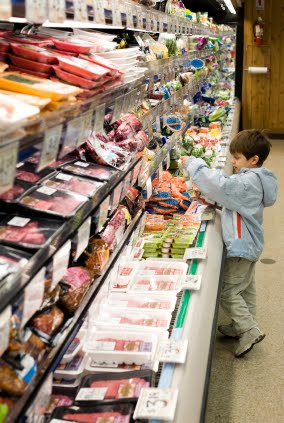
Supermarket Scavenger Hunt
By Julia MohamedThe next time you go grocery shopping, make it a more educational, enjoyable and literate experience for your kids with a Supermarket Scavenger Hunt!
1. Give each child a list of items to gather. Be as specific as possible (include a brand name, size, etc.) For instance, you might put:
□ One 18 oz jar of Kraft Crunchy peanut butter,
□ Three small green zucchinis,
□ One loaf of Dempsters 100% whole wheat bread.
It helps if your list is divided into categories, such as produce, meat, canned foods and, of course, snacks. That way, the kids will be in one specific area of the store at a time and you can keep an eye on them more easily.
For older children, throw in a few challenging items, such as ethnic foods. For instance, One jar of Red Shell Teriyaki sauce.
2. As each child brings you items, check to make sure they’ve picked out the right ones. If not, send your troops back out into the field.
3. Reward your kids with a healthy treat!
You can continue this activity when you get home. Include them when you’re making dinner by asking them to read out the ingredients in your recipe to you.
You're going to have to go grocery shopping anyway, and you know it's always a hassle. This great game is fun, it gives the kids a bit of freedom, and it gets them reading. A win-win! (Just do keep your eye on them, eh? I don't want to be getting any letters from parents saying their kids were lost for days in the zucchini aisle...)
Julia Mohamed is a freelance journalist. Photo: Wikimedia Commons.
Friday, July 9, 2010
Literacy games for in the car
Going on a road trip? Here are some great literacy games you can play in the car.
THE LICENSE PLATE GAME
● One person begins by spotting a license plate and announcing the letters (not the numbers) on it.
● Everyone else, in turn, must come up with a funny phrase using the letters of the license plate, in order. So for example, KES could become “kiss every squirrel” or “knights eating steak.”
ROAD-TRIP SCAVENGER HUNT
● Create a list of things to look for while you’re on the road.
● Your list can be adjusted, depending on where you’re travelling. For instance, a city scavenger hunt list may have: a flashing red light, someone talking on a cell phone, and a sign in a foreign language. A rural scavenger list could include: a horse, a tractor, road kill, a silo, a pond, and a gas station.
TRAVEL JOURNAL
● Before the trip, buy a note pad and box of crayons for each child in the car.
● Every day on your vacation, or for each memorable event that occurs, have the kids draw a picture and write about it in their travel journal.
● Give them some suggestions to get them started (“how about drawing the beach we were on this morning”) but after that, let their imaginations run wild. Encourage them to use as many words as possible. They may want to do the art in the evening in the hotel room or campground, and add the words in the car while you’re driving to your next destination. Young children can write one or two words (“Beach” or “Playing frisbee”) while older kids can write descriptions and even leave out the pictures altogether.
Julia Mohamed is a freelance journalist. This was her first assignment for GKR and I'm hoping it will be the first of many articles from her. (Hint, hint Julia.)
Photo: Ian Britton, FreeFoto.com.
Tuesday, July 6, 2010
The "Air Mail" game
My son’s friend likes to play “air mail” whenever he comes over on a playdate.It’s a great game and I know that it works on their literacy skills because I've seen improvements. It involves a bit of the adult’s time, but it’s such a fun game that I indulge them whenever they ask me to play.
Here’s the game:
The kids run upstairs and hole up in their bedroom.
They each, or together, write a note to me on a piece of construction paper.
Then they run downstairs and throw the note in my general direction – and then run giggling, like criminals, back upstairs where they slam the bedroom door.
So we’ve got lots of good elements here. There’s some kind of “chase” which involves getting the note to the adult without being seen. The adult can add to the excitement by either pretending not to see the note, or suddenly flinching in the child’s direction as through he’s going to chase them.
The first note from the children will be something like:
“We want a snack!” or “Ask us a question!”
Then the adult writes a note on the other side of the paper. I usually try to get some kind of dialogue happening, like: “Ask the Oracle a mysterious question.” Last time, I tied two snack bags of jelly candy onto the note and then pitched it at their bedroom door where it made a very satisfying – and disconcerting – thump. That was the kids’ cue to gingerly open the door to see if I was still there (I wasn’t) and retrieve my note.
If you can picture it, there is a lot of silliness, giggling, whispering between the kids and slamming of doors. There’s a lot of running up and down the stairs and a lot of suspense about what the note will say, whether they’ll get caught sending or retrieving their notes and whether they’ll get a treat.
In the meantime of course, there’s reading and writing. And I don’t make it easy for them. I use big words and I make sure there’s a pay-off for reading and understanding each message.
For instance, in our most recent game “Ask the Oracle,” the kids’ second note didn’t include a question. I figured they probably didn’t know what an Oracle was. So my next note told them to look the word up in the dictionary to find out what an Oracle could do for them. There was a pay-off to using the dictionary (because Oracles are cool).
Sometimes I make my notes into paper airplanes and throw them at the bedroom door. Sometimes I load them with a treat or even carrot sticks. Usually there’s a payoff for them writing another note back to me—maybe it’s a knock-knock joke they’ll have to ask for the answer to. Or sometimes it’s a nugget of information that they have to ask for more details about. Just something to keep the game going and keep the kids reading and writing. And giggling.
Photo: Wikimedia Commons, by Akkana.
Friday, June 18, 2010
Set up summer reading rewards
Stats show that kids who read throughout the summer have a great kick-start to school in September.And kids who don't, typically start the school year a bit behind.
With the school year ending, now's the time to plan your child's summer reading and writing projects.
Does your library have a summer reading program? Ours does; it's usually a large poster with about a dozen stickers you can earn over the summer by reading a book and then telling the librarian what you read.
The stickers are motivating because they "add" to the picture on the poster when you stick them on it. It's also nice for kids to have the undivided attention of the librarian while they're telling her about the books they've read.
This would be a pretty simple project to do at home. Instead of a poster, it's a big picture you or your child draws on bristol board - and a flat of stickers that have some kind of theme.
You could also arrange the stickers in a "reading reward chart" configuration. Each sticker represents a book the child has read and when he's read five (or 10) books he gets a reward of some kind.
It's important to put the poster or chart up on the child's wall so it's constantly motivating for him.
I don't know about you, but when my son was small I counted books that we'd read together as well as ones he'd read himself. Both types of reading are equally important and valuable, I think.
Related posts:
http://www.gkreading.com/2009/08/summer-reading-program.html
http://www.gkreading.com/2009/07/summer-reading-tips.html
http://www.gkreading.com/2009/01/motivate-your-child-with-reading-reward.html
Here's a link to the Summer Reading Club. This year's theme is "Destination Jungle" and the image with this post is this year's poster.
Monday, June 14, 2010
Numeracy activities
Again, I've put in bold the ones I think are particularly interesting.
- Estimate speed/distance/time relationships while travelling with your family. What was the average speed of the last trip you took?
- Examine maps with your child. Estimate distances. Find locations.
- Make a favourite recipe together.
- Log and graph sports scores over time. Find trends.
- Log and then graph daily temperatures over a one-week period with your family. (Make sure you take the temperature at the same time each day.)
- Estimate quantities and volumes during activities like gardening or planning food for a trip.
- Track three different stocks and see how they do in one month.
- Do mental calculations such as estimating grocery or restaurant bills.
- Pay cash for a purchase at the register. Check the correct change.
- Calculate how long it will take to save for a certain item your family would like to buy using your money from a part-time job or your allowance.
- Calculate a bat/run average for a specific baseball player.
- Make a weekly schedule with your family. Make time estimations for different activities.
- Read signs with your family while driving. Specifically look for advertising that has a math concept embedded in it. Talk about it.
- Explain how to calculate the tip at a restaurant. Do the calculation together.
- Open a bank account. Many youth accounts have brochures that explain interest rates. Read the literature together and decide which type of account will earn the best rates, minimize your transaction costs and meet your minimum balance plans.
- Look at sports statistics. Have a discussion about an interesting trend.
- Go grocery shopping together. Compare prices. Estimate price per kilogram. Which is the better price?
- Talk about items on sale. Do some Internet research to find out whether other vendors have similar products costing more or less.
- Talk about lotteries. Examine the odds.
- Talk about how a credit card works. Look at a statement together.
- Look at your electricity, gas or water bill. Which utility costs your family the most?
- Look at charts and graphs that appear in newspapers or magazines you receive. Find one that has information that interests your family. Talk about the chart or graph.
- Examine different cell phone packages. Which is the best value for your calling pattern and payment preferences?
Source: Toronto District School Board, TDSB.
Friday, February 26, 2010
Dry-Erase Crayons
Things that make you go "d'uh!"Dry-erase crayons. How good is that?
No mess, no smell, no drying out. But do they work? This is the best part - they really, really do work well.
The colours are deep and rich, and they write smoothly. Kind of like a cross between crayons and lipstick. Even on paper, which I don't advise because they smudge, they are vibrant and smooth-writing.
Combine this product with the idea about using a plastic plate as a mini-whiteboard, and you've got yourself a fun literacy-building activity. That wipes right off.
The dry-erase crayons come in packs of eight, with an "E-Z Erase Mitt" (in Canada it's an E-Zed Erase Mitt, which makes no sense but still wipes off just fine) and a built-in crayon sharpener.
I bet it won't take long before you're seeing them in classrooms and boardrooms. Fun! Crayola's selling them here for $5.48 a pack. Incidentally, I just Googled "dry-erase crayons" and found out that Sargent also makes them.
Sorry if this article sounds like a commercial for Crayola. I'm not affiliated with them, I don't get money from them - heck, I didn't even get a free box of crayons, just two sample crayons (which everyone at the For the Love of Reading conference also got). I just happen to like this product. Still, the article is a bit gushy. I will try to curb my enthusiasm just a titch in future.
Wednesday, January 6, 2010
Thank-you cards
So that means thank-you cards.
They're not optional. In our house if you don't want to write a thank-you card, that's fine - just give back the gift.
(Ooh, that sounds awful, but I do say it with a twinkle in my voice so he never actually chooses that option.)
How do you ensure sending thank-you cards doesn't turn into an activity that he comes to loathe?
Make it fun
* Offer options. Send gramma an e-mail (which the child types). Or text gramma.
* Make it an art project. The note could be a picture, a painting, origami, or just about anything else that you can write "thank-you" on.
* Send a photo. Have her put on the new shirt she got (or hold the toy); take a picture; and print it (at Shoppers Drug Mart or even on your black and white printer). Have the child write a couple of words on the back.
* Keep it short. Don't force your kid to write a two-pager. A couple of sentences will do.
* Give them the words. Tell your child: "Write something like, Dear Grampa, Thank you for the book. I'm thinking of you. Love, Simon." Then, he'll probably add something on his own.
* Younger children will enjoy putting their return address on the envelope, sticking a stamp on it and mailing it. (You can even let the child write gramma's address on the envelope herself - if it's illegible, just write it again, yourself, on the other side.)
* Have you ever explained how mail gets to gramma? Kids love that story, and it makes writing a thank-you note part of something bigger.
* Make sure gramma calls, e-mails or writes back when she receives your child's note. That provides your child with a reward that she'll remember the next time she has to write thank-you notes.
* If you have no one to send a card to, why not send a thank-you note to Santa? You might even get a letter back.
* Write thank-you notes yourself. Let your child see you doing it, too.
* Send a thank-you note to your child. Let him see how fun it is to get one.
* Don't make your child write a million notes. They can do one or two, and just sign any others which you write.
Start slowly, but make sure that every time they get a gift from someone distant, they write a note or send a e-mail. It's a lifelong habit your child will be thankful you passed along.
I used to send gifts to more relatives, but I stopped doing it when I never received a thank-you card or even a phone call. So that's another thing - kids who send thank-you notes tend to get more presents!
The beautiful thank-you notes in this picture are from my son's teachers. I think it's fantastic that teachers give kids thank-you notes; it really helps them see how important and thoughtful thank-you notes are.
Thursday, October 8, 2009
Munsch contest for Canadians
I’ll start with the best part – the winner gets a home visit from Robert Munsch! How exciting is that? (Extremely.)
To enter, simply write a short story with your family and submit it here.
If you win (and we’re gonna repeat this 'cause it’s awesome) Robert Munsch will come to. your. home. And he’ll read your story. And he’ll do a free reading at a school or library of your choice.
Plus, your story will be published in a newspaper or magazine and posted on the ABC Canada Literacy Foundation’s website.
Rules
*A child must be the primary author, but one adult must also be involved.
*250 words or less.
*The story must have a “singing” theme to tie in with the 2010 Literacy Day “Singing for Literacy” event.
Deadline
*December 11, 2009, 5 p.m. EST.
Family Literacy Day was created by ABC Canada and is held every year on Jan. 27. There’s lots of other stuff happening to celebrate that day.
Well, not only is this a great contest, but this is the first video I've ever embedded on my blog. Good for me! (Let's hope I don't get sued - I assume this video is copyright-free? I mean, it's basically an ad, right? And they'd want as many people to, uh, see it as possible? Gulp.)
Friday, September 4, 2009
Creating comics online
I made this comic myself - and it was fun.Imagine how much your child will enjoy creating their own story lines.
And afterwards, they can print them out and put them in a binder, or e-mail them to their friends.
Making comics not only ensures that your child will be reading, it means he'll be thinking logically about plot lines, beginning-middle-and-ends, character development and so many other things that are important to budding writers.
It's simple to do - and did I mention it's free (you don't even have to sign in).
The software is very intuitive, so there's no need to "learn" a software program.
You choose one, two or three boxes. Then you pick a character and his or her "mood." Then you choose a balloon and type in the words.
What I like about this is that it's easy enough so that kids can do it themselves, but sophisticated enough to provide lots of options for the child to make the cartoon his own.
Visit Make Beliefs Comix and try one yourself. Then let your child loose on the site.
Oh, and you know you and your spouse are gonna end up as characters in your kid's comic scenarios, right? The sacrifices we make to get our kids reading.
BTW, the image on this post is a bit blurry - but that's because I'm fairly inept at photoshop, not because of the site. It's very crisp.
Friday, August 21, 2009
Kids' writing contest (note: Americans only)
Here's a little gift for our friends to the south.Additional info: I received a very thoughtful response from a contest judge and from one of the Mrs. P. website creators explaining why the contest is limited to Americans only.
It's a legal thing apparently. With gift certificates involved, it would be too difficult to administer internationally (according to their lawyers. Yeah, that's what I said too. A-heh.).
Anyway, they said that if they get a lot of response from non-Americans, they'll consider holding another contest that's not US-exclusive. So there's your homework, everyone!
Tuesday, June 2, 2009
One-Page Wonders
A fun, one-page book your child will want to read.Monday, March 9, 2009
Great website - reading and math
I love Soft Schools.A wonderful kindergarten teacher told me about it years ago, and I’ve used it ever since.
At Soft Schools you can create fun puzzles, tailor-made for your child, and then print them out or let your child do them online.
For instance, there are:
Word Scrambles
Use your child’s name, relatives, and favourite things in the puzzle. Hit “Generate” and it creates the puzzle for you to print out.
Phonics activities
Online flash cards and phonics games such as the phonics scramble using short and long vowels.
Games
Right on the home page you can access connect-the-dots games, fishing games featuring subtraction, math worksheets, colouring pages with the alphabet, money worksheets and a great balloon pronoun online game. It also has activities dealing with science, geometry, fractions, chemistry, integers, rhymes, and lots more.
I often use the site to create math worksheets for my son, who loves to solve math problems. You tell it how big the numbers can be (for instance, no solution larger than 100) and it creates a worksheet so your kids can show you how smart they are.
No, that's not an out-of-focus copy of their logo - that's their logo. It's soft. Get it?
Tuesday, February 17, 2009
How to get mail
Remember when you were little, and some mail came addressed to you? It was fantastic! And of course, when kids get mail... they read it.
Here are some ways to help your child get some mail:
*You get mail when you send mail. Help your child send a letter or even a drawing to one of her friends, relatives or neighbours. (Neighbours don't even require stamps.)
*Send him a letter yourself. Let him get it from the mailbox when it comes.
*Subscribe to a kids' magazine. He'll get mail every month.
*Encourage your child to write to an author or even a politician. OK, a celebrity then.
*Help your child join a club, like the Toronto Blue Jays Kids' Club. They send regular newsletters. And tickets.
*Put in a call to gramma or grampa. They're usually good for a letter.
*Write to Santa. He always writes back.
Actually, do you know if Santa writes back in the off-season? Me neither. I think we'll give it a try. After all, he must be getting a bit bored around now...
Friday, October 3, 2008
Great make: plasticine books
This great comment from Cathy was too good to leave in the comments section.Hi Joyce:
You've got me thinking about what sorts of things encouraged my boys to enjoy reading when they were small. One idea that really worked and was a lot of fun:
When my son was about seven or eight years old, he spent several snowy afternoons writing a simple story and illustrating it with playdough art. He was inspired by the Barbara Reid books, particularly "Two by Two," which is a wonderful depiction of "Noah's Ark."
Ryan worked for hours and hours on his "illustrations." I covered a flat surface for him with plastic and he produced eight different pictures. Then I took photos of each illustration and he dictated while I typed out the words for each page.
We put words and pictures together and created a book. Ryan was really proud of it. I think his grandpa was as well because he took Ryan's book to church where Barbara Reid was also a member. She was kind enough to respond with a letter to my son.
A nice memory!
Cathy
The image on this page is a plasticine picture by Barbara Reid, from her new book, Fun With Modeling Clay. Here are the step-by-step instructions for this project.