Showing posts with label projects/crafts for you. Show all posts

Tuesday, December 21, 2010

Take 30 seconds for literacy this holiday

Think about literacy.

Take 30 seconds during the holidays - today - to reflect on how you can help your child become a better reader, enjoy books more and have greater access to books.

Just taking the time to focus on literacy will bring your child one step closer to enjoying reading more.

Here are some ideas to help you answer the question:

"How can I help my child enjoy reading more?"

* Extend your child's bedtime - as long as he's reading, he can stay up a bit later.

* Take your child to the library.

* Buy a great book and put it on your child's pillow for her to discover tonight.

* Buy yourself a good book. When kids see their parents reading, they're more likely to read themselves. (Have you read Andre Agassi's new biography Open? Even if you don't like sports, biographies or Andre Agassi - you will enjoy this great, fast and engaging read.)

* Read with your child tonight, even if he's already reading by himself.

* Buy books at Goodwill or another second-hand store.

* Rent your child the movie of a famous book. Buy the book too.

* Suggest that the grandparents purchase a magazine subscription for your child.

* Buy your child a booklight. Let him use it tonight after lights-out.

* Get your son a fact-based book like the Guinness Book of Records or one with lots of adventure like Percy Jackson and the Lightning Thief (the graphic novel has just come out).

* Get your daughter a book with lots of great characters and developed relationships, or one with a wonderful, empowered heroine like Eloise.

* Don't ever give up. Every second you spend with your child on reading is quality time and an investment in his future.

Image: Wikimedia Commons, by this author.

Monday, November 22, 2010

Save the Words

Won't you adopt a word?

You don't normally think of the Oxford English Dictionary people as silly, but they've developed a project that's pretty goofy, and it's something you can do with your kid to get her thinking about language.

They've rounded up hundreds of words that don't get used much any more. Words like gumfiate (to swell), lambition (licking) and vellicle (something that pinches or holds fast).


They've taken all of these nearly extinct words and knitted them into a virtual quilt, which you'll find here.

When you move your mouse over the words, they'll call out to you: "Pick me! Pick me!" They want you to adopt them.

You can find a word or two that you like and click on them. That will bring up its definition, and a form that allows you to "adopt" it. (Like all adoptions, you first have to register. Unlike human adoptions, it's free.)

Adopting a word means pledging that you'll try to bring it back into the mainstream. You'll use it in conversation and in writing, and you'll explain it to people.

Save a Word is meant to be a fun concept to get people thinking about words. It's a great resource to use to talk to your child about the fact that words evolve and how our language has changed.

Monday, November 1, 2010

Promote literacy: four important activities

There’s a fourth promoter of literacy.

You know that I’m always going on about the three most important things you can do to turn your kid into a great reader:

1) Read to her every day.
2) Have lots of books scattered throughout your house.
3) Let her see you reading.

Research tells us that if you do those three things, you’re more likely to have a kid who loves to read.

A Grade 1 - 2 teacher at my son’s school told me about another one: The number of books she reads/looks at/has read to her.

Mr. Remisch told me that kids who “go through” books at a fairly good clip tend to be lifelong readers. It makes sense; it’s kind of an extension of #2—exposing her to books, having them around her.

Mr. Remisch has a wonderful plan to get the kids in his class to “get through” a lot of books. He uses an incentive.

The kids in his class will write down the title of every book they read, along with as much as they can or want to say about the book. When they get to 30, they’ll get a certificate.

For a six-year-old, that’s a pretty solid incentive. In fact, just keeping track—or having your teacher keep track—of the books you’re reading is enough to keep a kid reading.

In this exercise, Mr. Remisch isn't concerned as much about the quality of the reading material, as the quantity. He’s not trying to make kids read specific things, here; he’s trying to expose them to books. Lots of books.

He’s setting the stage for later years, when the quality of the reading material will become more important.

He doesn’t want kids going home and staying up until two in the morning, reading all 30 books in one week, so he’ll probably set a limit of three books a day.

And he says it is important that the child understand what she’s reading, so there will be some discussions about the books. And for every, say, dozen or so books, he’ll ask the child for a bit more detail.

A reading incentive chart with a nice reward is a great way to expose your child to books and get her reading.

Here’s an earlier article we wrote on Reading Reward Charts.

Thursday, October 28, 2010

Mother-Son bookclub part II

Our mother-son book club met again this week.

It’s a great example of parents taking their children’s literacy into their own hands. And anyone can do it – you can do it.

The boys drew, read, wrote, ate,
chatted, answered quiz questions
and had an amazing time.
Once again, the evening was total chaos… and I wouldn’t have changed a thing. There were boys writing, boys reading, boys drawing maps of faerie sightings in their neighbourhood, boys eating cupcakes, boys talking (in very loud voices—ok, shouting) about books, boys presenting at the front of the room, boys running around and overall, boys enjoying and sharing their experiences with books.

There were about half a dozen moms wondering what the heck was going on. (The one dad remained very calm, taking it all in stride.) The moms all had the same expression on our faces. It said: “This is chaos!”

Yes, it was chaos. It was wonderful chaos.

It was the way boys often need to learn, to connect, to delve into books, to share. Touching things and doing things and running around occasionally and eating snacks—while they were learning.

Every boy there walked away knowing that for a month, while they were living in “The Spiderwick” world—there were a dozen other boys in exactly the same world. And that’s the whole point of the bookclub.

Our itinerary:
Amongst the chaos, quite a lot was accomplished.

The book this month was The Spiderwick Chronicles (Book I), about three siblings who move into an old house and discover a secret world of faeries and goblins.

Two families hosted; their boys created a quiz about the book and its characters. They called out questions and the audience members answered.

They also gave out hand-outs: one asked kids to draw a map of their neighbourhood, showing where faeries and goblins could be found; another had kids draw their own “field guide” book cover; another gave the first three lines of a poem and had the child create the final line; still another taught “deductive reasoning.” So there was something at both ends of the spectrum, for kids who prefer drawing and kids who prefer writing.

Joulie handed out our special shrinky-dink I.D. badges that we’d created last month. They looked fantastic and the kids were excited to see their creations turn out so well.

And then Joulie created special I.D. cards for each child, which she’s brought home to laminate. (Yes, Joulie is our neighbourhood supermom who not only has a shrinky-dink machine, but apparently a laminator as well!) Each card has a photo of the child, which Joulie must have taken last month, wearing a fake moustache. I completely missed that she did that – when does she do these things?!

We read out a couple of the stories the kids started last month. Remember the envelopes, on which each child wrote the beginning of a story – we each took one home to continue the story. They were handed out yet again, for the kids to develop the story a bit further at home.

There was a lot going on, all the time. The boys could draw or read or write or eat or answer trivia questions—sometimes all at once. It was so great, I can’t even tell you.

You’ve got to start up a kids’ book club in your neighbourhood. (Just don’t ask to borrow Joulie, ’cause you can’t have her.)

Next month:
Our book selection for next month is Big Nate: In a Class by Himself.

In December, we're doing The Red Pyramid, which is a really big book so we're giving two months' notice. We're also suggesting that parents check the audio version of the book out of the library (you can get the CDs or download an MP3) because the book will be a bit too ambitious for some kids to read.

Monday, August 23, 2010

Back to school 2010

By Julia Mohamed

It’s nearly back-to-school time! Time to go from running wild and free to becoming a studious student once again. Here are a few ideas to help make the transition as smooth as possible:

Goal Journal
Have your kids contribute to a nightly journal. Begin now, with their anticipations and goals for the upcoming year, and continue to use it as the year progresses. It will help get them into the routine of writing again, and it’ll be great to look back on it later in the year. They can do all of the writing, dictate to you, add some pictures or make it a combination of everything.

Great sites
School means reports and essays. Here are great, kid-friendly websites where kids can search for the answers to questions on just about anything.

Homework Helper
This site offers categories like “Science, History, World, Sports and exercise.” From there, kids can drill down until they find answers to questions they have on just about anything. Includes facts and information on Canada, plus a “World” category.

It’s a non-profit website and each category uses a specialist in the field to write the information and answer kids’ questions. If you can’t find what you’re looking for on the site, you can ask their experts a question and they’ll e-mail you back. They'll also send parents links to kid-friendly websites.

Published by Pearson publishing, this site offers information and facts on lots of different subject areas, for kids K to 8. It also has an online atlas, dictionary and encyclopedia and some online games and quizzes (for instance, hangman, Star Wars quizzes, an interactive periodic table, Sudoku, how to write a book report and much more.)

Funschool Kaboose
Funschool Kaboose is a Disney site with great information, games and crafts for kids from preschool to grade 6. It also features sections for parents and educators.

Stock up on school supplies
Before heading out, prepare a list of the school supplies you need. Why not make it a scavenger hunt? Be sure to be specific when you’re writing your list: Number 2 pencils, blue and red ballpoint pens, a calculator, white erasers, a one-inch three-ring binder, etc. Refer to our article, Supermarket Scavenger Hunt for details on how to create the perfect hunt!

Reading - every night
Keep reading to your child every night. Create a reading log for your kids. A simple chart with headings including “Date,” “Title,” “Author,” “Number of Pages Read,” and “Amount of Time Spent Reading” can help keep track of how much they read. For every milestone, give your child a reward. Here’s a past GKR article on Reading Reward Charts.

If you only get a chance to do one thing from this article, check out the websites Julia found - they have a great wealth of information your kids will appreciate when they start getting into essay writing time.

Julia Mohamed is a freelance journalist.

Monday, August 16, 2010

Supermarket Scavenger Hunt

By Julia Mohamed

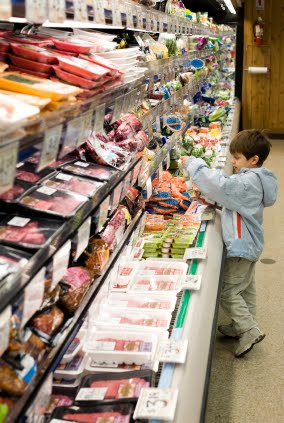
The next time you go grocery shopping, make it a more educational, enjoyable and literate experience for your kids with a Supermarket Scavenger Hunt!

1. Give each child a list of items to gather. Be as specific as possible (include a brand name, size, etc.) For instance, you might put:
□ One 18 oz jar of Kraft Crunchy peanut butter,
□ Three small green zucchinis,
□ One loaf of Dempsters 100% whole wheat bread.

It helps if your list is divided into categories, such as produce, meat, canned foods and, of course, snacks. That way, the kids will be in one specific area of the store at a time and you can keep an eye on them more easily.

For older children, throw in a few challenging items, such as ethnic foods. For instance, One jar of Red Shell Teriyaki sauce.

2. As each child brings you items, check to make sure they’ve picked out the right ones. If not, send your troops back out into the field.

3. Reward your kids with a healthy treat!

You can continue this activity when you get home. Include them when you’re making dinner by asking them to read out the ingredients in your recipe to you.

You're going to have to go grocery shopping anyway, and you know it's always a hassle. This great game is fun, it gives the kids a bit of freedom, and it gets them reading. A win-win! (Just do keep your eye on them, eh? I don't want to be getting any letters from parents saying their kids were lost for days in the zucchini aisle...)

Julia Mohamed is a freelance journalist. Photo: Wikimedia Commons.

Wednesday, July 28, 2010

Write your kid a letter

Have you sent your kid a letter this summer?

What a great thing to do!

When you're bored at work - instead of re-checking your e-mail for the tenth time, or surfing, do something that will help your kid... write her a letter.

It takes, like, 10 minutes and it will be one of the most rewarding things you will do all day. Use a big, easy-to-read font like Times 18. (Resist using a cartoon or handwriting font. They may look fun, but they're very hard to read. The easiest ones to read are serif fonts, like Times.)

You don't have to say anything profound. Just chat, let her know what's happening at work, tell her that you're proud of her, ask her what she wants to do this weekend.

A letter from you will let her know that you're thinking of her, it will give her some insight into your day and it's a great way to get your kid reading!

When you're finished your letter, actually mail it - don't just bring it home. Half the excitement is going to the mailbox and getting something that's been sent to you.

It's also a good idea to include a self-addressed, stamped envelope that your child can use to write you back. (And if you use your work address, you'll get something at your desk in a couple of days besides conference flyers and departmental invoices!)

Writing your kid a letter is one of the greatest ways to spend 10 minutes. For you, and for your kid.

Don't have a kid? Write your grandchild a letter. A neighbour. A friend's kid. Santa (don't need a stamp for that one!). Snail-mail is fun... and it's still pretty cheap (especially if you sneak your letter in to the company mailbox and let the firm pay for your postage).

Image: Wikimedia Commons, by Deadhoax.

Tuesday, July 6, 2010

The "Air Mail" game

My son’s friend likes to play “air mail” whenever he comes over on a playdate.

It’s a great game and I know that it works on their literacy skills because I've seen improvements. It involves a bit of the adult’s time, but it’s such a fun game that I indulge them whenever they ask me to play.

Here’s the game:
The kids run upstairs and hole up in their bedroom.
They each, or together, write a note to me on a piece of construction paper.
Then they run downstairs and throw the note in my general direction – and then run giggling, like criminals, back upstairs where they slam the bedroom door.

So we’ve got lots of good elements here. There’s some kind of “chase” which involves getting the note to the adult without being seen. The adult can add to the excitement by either pretending not to see the note, or suddenly flinching in the child’s direction as through he’s going to chase them.

The first note from the children will be something like:
“We want a snack!” or “Ask us a question!”

Then the adult writes a note on the other side of the paper. I usually try to get some kind of dialogue happening, like: “Ask the Oracle a mysterious question.” Last time, I tied two snack bags of jelly candy onto the note and then pitched it at their bedroom door where it made a very satisfying – and disconcerting – thump. That was the kids’ cue to gingerly open the door to see if I was still there (I wasn’t) and retrieve my note.

If you can picture it, there is a lot of silliness, giggling, whispering between the kids and slamming of doors. There’s a lot of running up and down the stairs and a lot of suspense about what the note will say, whether they’ll get caught sending or retrieving their notes and whether they’ll get a treat.

In the meantime of course, there’s reading and writing. And I don’t make it easy for them. I use big words and I make sure there’s a pay-off for reading and understanding each message.

For instance, in our most recent game “Ask the Oracle,” the kids’ second note didn’t include a question. I figured they probably didn’t know what an Oracle was. So my next note told them to look the word up in the dictionary to find out what an Oracle could do for them. There was a pay-off to using the dictionary (because Oracles are cool).

Sometimes I make my notes into paper airplanes and throw them at the bedroom door. Sometimes I load them with a treat or even carrot sticks. Usually there’s a payoff for them writing another note back to me—maybe it’s a knock-knock joke they’ll have to ask for the answer to. Or sometimes it’s a nugget of information that they have to ask for more details about. Just something to keep the game going and keep the kids reading and writing. And giggling.

Photo: Wikimedia Commons, by Akkana.

Monday, June 14, 2010

Numeracy activities

A few posts ago, I listed some great literacy activities from our school board. Here are some numeracy activities to get kids doing math (same source, TDSB).

Again, I've put in bold the ones I think are particularly interesting.
  • Estimate speed/distance/time relationships while travelling with your family. What was the average speed of the last trip you took?
  • Examine maps with your child. Estimate distances. Find locations.
  • Make a favourite recipe together.
  • Log and graph sports scores over time. Find trends.
  • Log and then graph daily temperatures over a one-week period with your family. (Make sure you take the temperature at the same time each day.)
  • Estimate quantities and volumes during activities like gardening or planning food for a trip.
  • Track three different stocks and see how they do in one month.
  • Do mental calculations such as estimating grocery or restaurant bills.
  • Pay cash for a purchase at the register. Check the correct change.
  • Calculate how long it will take to save for a certain item your family would like to buy using your money from a part-time job or your allowance.
  • Calculate a bat/run average for a specific baseball player.
  • Make a weekly schedule with your family. Make time estimations for different activities.
  • Read signs with your family while driving. Specifically look for advertising that has a math concept embedded in it. Talk about it.
  • Explain how to calculate the tip at a restaurant. Do the calculation together.
  • Open a bank account. Many youth accounts have brochures that explain interest rates. Read the literature together and decide which type of account will earn the best rates, minimize your transaction costs and meet your minimum balance plans.
  • Look at sports statistics. Have a discussion about an interesting trend.
  • Go grocery shopping together. Compare prices. Estimate price per kilogram. Which is the better price?
  • Talk about items on sale. Do some Internet research to find out whether other vendors have similar products costing more or less.
  • Talk about lotteries. Examine the odds.
  • Talk about how a credit card works. Look at a statement together.
  • Look at your electricity, gas or water bill. Which utility costs your family the most?
  • Look at charts and graphs that appear in newspapers or magazines you receive. Find one that has information that interests your family. Talk about the chart or graph.
  • Examine different cell phone packages. Which is the best value for your calling pattern and payment preferences?

Source: Toronto District School Board, TDSB.

Wednesday, June 9, 2010

Get involved in your child's school

Enrich your child's learning, help your teacher, get involved.

I despair when parents complain that their kids aren’t getting what they need from their school.

I despair, not because the children aren’t getting what they need from their school, but because we parents have been conditioned to accept those terms lying down. And I strongly believe that if your child is not getting what he needs from school, you can change things.

We parents need to recognize our power. We need to ignore the “stop” signs that have been put up around us—Stop! You can’t participate in school. Stop! You we can’t go into the classroom. Stop! You can't change the curriculum.

School is not some sacrosanct chamber. It’s where our children spend the vast majority of their time during the day. School is where our children are living their lives.

And if they’re not getting what they need from school, we can change that. As parents, we need to change that. We need to add stuff, we need to get the teachers to add stuff, we need to change stuff.

We can raise money for great books if that’s what’s needed—or just make a donation to the classroom of appropriate books (with input from the teacher, of course). We can find interesting programs that are being offered and get them incorporated into our school’s curriculum. At our school, for instance, the parent council funded a chess program so now all of our kids, from grades 1 to 6, get instruction in chess once a week.

We can talk to the teacher and the principal to find out how we can help. Taking a look at our own skill set is a good place to start. That’s how I arrived at the idea to do a weekly current events session in my child’s class. I’m a journalist and I love the news, so I simply asked the teacher if he’d be interested in my bringing newspapers to the kids once a week.

How about buying a few sets of Boggle or Scrabble and introducing your child’s class to a weekly game that gets them thinking and spelling? Or researching excellent fun learning websites on the Internet, so that when your child’s computer time comes around, the teacher has some good options to offer the kids.

Or how about introducing chess to your child’s class? Chess is actually extremely easy to play at a beginner level; once you know how each piece is allowed to move, you’ve pretty much got it. (It only gets hard at more advanced levels.) You can teach yourself how to play, buy or borrow a few sets and then – presto – you’re bringing chess to your child’s classroom once a week. And as our chess instructor will readily point out, the game teaches children how to think ahead, which is a valuable life skill.

If you can throw off the shackles of “parents should not interfere in school” and get involved, there are thousands of ways in which you can customize your child’s learning, help the teacher and enrich the school’s curriculum. And that’s a good situation for everyone.

I'm not suggesting some radical, half-cocked approach here. I'm talking about taking your ideas to the teacher or the principal and letting them know what you can offer and why it would benefit the school. Working with them as a partner. And of course, the benefit to you is that your child will then be exposed to new and extended learning. I mean, like, don't just do stuff for other classrooms - do it for your own kid's. It's a win-win.

Thursday, May 27, 2010

Current events


I’ve been doing current events at my son’s school.

I approached my son’s teacher a few weeks ago, and proposed a weekly, half-hour current events discussion for the grade 3 / 4 class. My son’s teacher is very cool, and progressive and totally supported the idea. He also helped to provide structure for my amateur (I’m a journalist, not a teacher) efforts.

I’ve gone in twice now, and the kids do seem to enjoy it.

It occurred to me that what I’m doing with the class can easily be done by parents (and educators) with their own kids.

The Current Events class
The first class was a review of the news from the past few days. I wanted to tell the kids about some of the major news stories that were unfolding – like the oil spill and the G20 summit that’s coming to our city this summer. And then I just picked out a bunch of interesting stories that I thought kids could relate to.

I held up each newspaper article, read the headline and then explained what the article was about. I also gave a bit of information about the various newspapers available in Canada and what they were all about. I talked to them about “how” to read a newspaper – for instance, you don’t have to read every word of an article – and how to understand headlines even though they’re often written in a very truncated way.

We talked about the G20 summit – what it is and the various ways in which it would impact the city. And the oil spill, and what BP was trying to do to stop it (including shoving golf balls into the pipe! We had a show of hands as to how many kids thought that would work.)

And then we reviewed a handful of other stories including the discovery of some new species in New Guinea, the fact that our city is missing millions of dollars in unpaid speeding ticket fines, and Robert Munsch’s revelation of his alcohol addiction (we were careful to present that in a positive light—how he had overcome adversity).

The children were very interested in the news and how it affects them. For many of them, it was an introduction to parts of the newspaper that didn’t have comics or Sudoku.

And then the teacher did something really, really smart. He took a vote on which stories the kids wanted me to follow up on the next week. That way, we could see what the kids were interested in and hone the presentation to be of the most interest.

The kids picked the G20, the oil spill and the species, which I thought was an incredibly mature list—this is some heavy stuff.

Week 2
The second week I followed up on the G20: the $1B security tab for the summit, and the many tourist attractions (including the CN Tower) that will be shut down during the talks. And I was also able to report that the golf-ball idea is going ahead – and that one of the back-up plans is to use human hair to clog the spill. Seriously. (No one in the class thinks that will work, either. Maybe BP should call us.)

And we added in a few new stories that were interesting that week: the boy in Alberta who was refused the right to wear a kilt to his graduation (his principal has since changed his mind); the million works of art that are currently in the hands of the Toronto District School Board and which may be loaned out to schools; and the fact that vending machines in our city’s recreation centres will be going healthy (the class cheered).

Reading the news is a fantastic literacy exercise. Kids are keen to know what’s going on around them, but newspapers can be daunting. Headlines are hard to read and articles generally require a lot of general and historic knowledge in order to understand them. But once an adult puts things in context, kids just jump right in.

And that’s a gigantic step towards getting kids reading.

Sorry I haven’t been blogging as much as usual – but you can see how busy I’ve been. Add our school’s FunFest and other activities to the mix, on top of my “money-making” job and it hasn’t left much time for blogging. But I hope to be back on the horse again soon.

Tuesday, March 2, 2010

Fishy literacy game

A do-it-yourself game that helps early readers connect capital letters with their lowercase equivalents. Thank you to guest blogger Dawn Little, for this post.

Here is a fun letter match game to help your child recognize and match capital letters to lower case letters.

1. Gather your materials: One small magnet, a wooden dowel, yarn, glue, construction paper, markers, scissors, and 52 paper clips (and 26 googly eyes, if you'd like).

2. Make a fish template on a piece of construction paper. Use the template to cut out 52 fish (26 capital letters, 26 lower case letters). Give your fish smiles and either make an eye using marker or glue a googly eye on each one. Attach paper clips to the mouth of each fish, like a fish hook.

3. Make a fishing pole by tying a piece of yarn to one end of the dowel. Put glue on one side of the magnet and attach it to the hanging end of the yarn.

4. Scatter the fish on a table or the floor. Give your child the fishing pole and call out letters, calling out a capital letter first. After your child catches that fish, call out the lower case letter match. Ask her to match the lower case letter with the capital letter.

It's a good idea to use only half the alphabet at a time; for instance, A through I. Do J through K next time; you don’t want to overwhelm your child. Plus, if you only do half the alphabet, you’ve separated out the tricky b/d and p/q, which can be confusing for kids.

I adapted this game from the School of Fish Game at No Time for Flashcards.

Have fun fishing!

Dawn Little (aka Links to Literacy on Twitter) blogs at Teaching With Picture Books, providing educators with picture book lessons based on comprehension strategies and the Six Traits of Writing. She also blogs at The Literacy Toolbox, where she provides educators and parents with tips and tools to enhance the literacy lives of children. She is the founder and owner of Links to Literacy, a company dedicated to providing interactive literacy experiences for children and families.

Did you spot those cute little Dawn's-daughter's-toes in the bottom left of the photo? Cute little fisher-girl.

Wednesday, January 6, 2010

Thank-you cards

A great literacy activity.

Your kids have probably just received a bunch of gifts, and I'm betting that at least some of the senders weren't in the room when they were opened.

So that means thank-you cards.

They're not optional. In our house if you don't want to write a thank-you card, that's fine - just give back the gift.
(Ooh, that sounds awful, but I do say it with a twinkle in my voice so he never actually chooses that option.)

How do you ensure sending thank-you cards doesn't turn into an activity that he comes to loathe?

Make it fun
* Offer options. Send gramma an e-mail (which the child types). Or text gramma.

* Make it an art project. The note could be a picture, a painting, origami, or just about anything else that you can write "thank-you" on.

* Send a photo. Have her put on the new shirt she got (or hold the toy); take a picture; and print it (at Shoppers Drug Mart or even on your black and white printer). Have the child write a couple of words on the back.

* Keep it short. Don't force your kid to write a two-pager. A couple of sentences will do.

* Give them the words. Tell your child: "Write something like, Dear Grampa, Thank you for the book. I'm thinking of you. Love, Simon." Then, he'll probably add something on his own.

* Younger children will enjoy putting their return address on the envelope, sticking a stamp on it and mailing it. (You can even let the child write gramma's address on the envelope herself - if it's illegible, just write it again, yourself, on the other side.)

* Have you ever explained how mail gets to gramma? Kids love that story, and it makes writing a thank-you note part of something bigger.

* Make sure gramma calls, e-mails or writes back when she receives your child's note. That provides your child with a reward that she'll remember the next time she has to write thank-you notes.

* If you have no one to send a card to, why not send a thank-you note to Santa? You might even get a letter back.

* Write thank-you notes yourself. Let your child see you doing it, too.

* Send a thank-you note to your child. Let him see how fun it is to get one.

* Don't make your child write a million notes. They can do one or two, and just sign any others which you write.

Start slowly, but make sure that every time they get a gift from someone distant, they write a note or send a e-mail. It's a lifelong habit your child will be thankful you passed along.

I used to send gifts to more relatives, but I stopped doing it when I never received a thank-you card or even a phone call. So that's another thing - kids who send thank-you notes tend to get more presents!
The beautiful thank-you notes in this picture are from my son's teachers. I think it's fantastic that teachers give kids thank-you notes; it really helps them see how important and thoughtful thank-you notes are.

Tuesday, December 22, 2009

Great homework

Our son's teacher created an awesome homework assignment.

And it's something parents could do, too.

I just asked my son and his friend if they've finished their homework (it's just two days into the winter break). They both said yes. Even though there was a lot of reading involved, and some math. Here's why.

It's a detective story. It covers about three pages (yours could be shorter), and leads the reader through several interesting "logic puzzles."

Here's a sample plot:
A detective receives a note.
The note says there's going to be a bank robbery.
The reader (child) has to figure out when the robbery is going to take place, at which bank, and who the culprit is.

The clues, and the steps to solve them, are in the story.

For instance, the note can say, "A robbery is going to take place at 1 2-1-14-11 9-14 20-15-18-15-14-20-15."
Detective Bill thought, "I can figure out the blanks by substituting letters for each number. For instance, "A" is "1"."

So now, the message says: "A robbery is going to take place at A BANK IN TORONTO."

Then the detective had to figure out which bank.
He got a list of banks like this:
Bank of Montreal, 24 Quebec St., 431-1435
Royal Bank, 91 Queen St., 987-1243
TD Bank, 43 Canada St., 332-1322

The note told the detective the robbery would be at bank #428.
The detective decides to use a formula for figuring out which one was #428. (Something like, add all of the numbers in each phone number and multiply them by the street number).

You get the idea.

The last clue was about whodunnit.
The note was signed, "Raymo."
The reader had to rearrange the letters to figure out that the culprit was the city's "Mayor."

Kids will get excited about reading and math when the story is about them, and lets them figure things out. Your story could be about a detective who has to solve a mystery surrounding a baseball team. Or with Hannah Montanna. Or in a dinosaur museum. Or a video game parlour. Or whatever your kid's into.

Use your child's name in the story, the names of siblings, pets, her school - whatever will catch her eye as she's reading. She'll love it!

So right now you're surfing the net. You're reading this blog (way to go, you rock, incidentally). But obviously you've got a few minutes before the boss comes back. So use this time to write a quick story. Steal liberally from my ideas, above (after all, I stole them from my son's teacher, a-hem). Don't even worry about including a "mystery" if you want - just make it a story. Don't worry if it's simple, if it's not as good as Robert Munsch would do. Your kid will love it - and she'll be reading.
Photo: iStock.

Saturday, December 5, 2009

Make a book for Christmas

This is a great time to make your child a book for Christmas or Hannukah.

Children of all ages are motivated to read a book about their favourite subject - themselves.

Here's how
*Buy a small scrapbook with stiff pages. (Craft stores have them. You can also use a photo album.)

*Select five to 20 photos of the child, her favourite activities, family and friends, and events from the year. I usually print them out on one of those machines in Shopper's Drug Store - they're just $.23 per print, or so and I don't have to wait.

*Put them in some kind of logical order.

*Tape them into the book.

It's best to type the text for the book on your computer, print it out, and cut it into lines that you can paste below each photo. Use a simple font like Times New Roman (don't get fancy - the goal is legibility.)

For really young children, print one or two words in a large font under each picture:
"Susie"
"Daddy"
"Susie's teddy"

For slightly older children, try one-liners:
"Sebastian turned 4 this year!"
"Sebastian loves to play hockey."
"Daddy and Sebastian at the museum."

For kids who are reading, try writing your own short story.
Each page can have a few lines or a paragraph, with pictures on some pages. Reflect on the year, and write about some of the highlights:
"Our trip to Hawaii was incredible. Dad got seasick on the boat, and Mom lost her wedding ring - but she found it again! I couldn't wait to try Mahi-Mahi - it was delicious."

Another idea is a book that shares some of your insights about your child.
"Daddy and I love you, and we are so proud of you for always trying to do the right thing. Remember when Bradley at school was getting bothered by that boy? We were so proud when you stepped in and stood up for your friend. That took courage!"

Or, help your child keep track of milestones.
"I am a good hockey player. Just two years ago, I was barely skating... now I'm a fast skater and I can do a hockey-stop. I played in goal twice this year; I've scored six goals and gotten a whole bunch of assists. The coach says I'm a good team player. Next year, I want to join the Select team."

Other tips:
In your captions, try to go beyond what's obvious in the picture: "At the beach," could be "This is where we found the big orange conch shell."

Write from the child's perspective, "I, I'm" and the book will be more interesting to them.

Include the names of your child's friends. Wouldn't you love a record of names and photos of your friends from when you were really young? Do it for your child.

Cut some of your photos into shapes if they don't fit on the page.

Pick a great photo for the front of the album, and don't forget to date your book.

A book about your child will be something that fascinates him, and makes him want to read every word. He'll pick it up again and again - and for years to come.

The book in the picture is one that I started for my son this time last Christmas, but never finished. I picked it up, blew off the dust (literally) and flipped through it. I teared up - you forget how fast they grow, and how small they were last year! I'm going add the captions and a photo on the front and give it to him this year.

Thursday, October 8, 2009

Munsch contest for Canadians

Here’s a very exciting contest for Canadian kids.


I’ll start with the best part – the winner gets a home visit from Robert Munsch! How exciting is that? (Extremely.)

To enter, simply write a short story with your family and submit it here.

If you win (and we’re gonna repeat this 'cause it’s awesome) Robert Munsch will come to. your. home. And he’ll read your story. And he’ll do a free reading at a school or library of your choice.

Plus, your story will be published in a newspaper or magazine and posted on the ABC Canada Literacy Foundation’s website.

Rules
*A child must be the primary author, but one adult must also be involved.
*250 words or less.
*The story must have a “singing” theme to tie in with the 2010 Literacy Day “Singing for Literacy” event.

Deadline
*December 11, 2009, 5 p.m. EST.

Family Literacy Day was created by ABC Canada and is held every year on Jan. 27. There’s lots of other stuff happening to celebrate that day.

Well, not only is this a great contest, but this is the first video I've ever embedded on my blog. Good for me! (Let's hope I don't get sued - I assume this video is copyright-free? I mean, it's basically an ad, right? And they'd want as many people to, uh, see it as possible? Gulp.)

Friday, September 4, 2009

Creating comics online

I made this comic myself - and it was fun.

Imagine how much your child will enjoy creating their own story lines.
And afterwards, they can print them out and put them in a binder, or e-mail them to their friends.

Making comics not only ensures that your child will be reading, it means he'll be thinking logically about plot lines, beginning-middle-and-ends, character development and so many other things that are important to budding writers.

It's simple to do - and did I mention it's free (you don't even have to sign in).

The software is very intuitive, so there's no need to "learn" a software program.
You choose one, two or three boxes. Then you pick a character and his or her "mood." Then you choose a balloon and type in the words.

What I like about this is that it's easy enough so that kids can do it themselves, but sophisticated enough to provide lots of options for the child to make the cartoon his own.

Visit Make Beliefs Comix and try one yourself. Then let your child loose on the site.

Oh, and you know you and your spouse are gonna end up as characters in your kid's comic scenarios, right? The sacrifices we make to get our kids reading.

BTW, the image on this post is a bit blurry - but that's because I'm fairly inept at photoshop, not because of the site. It's very crisp.

Wednesday, July 22, 2009

Willy Wonka to the rescue

Willy Wonka has been a huge success.

As you may remember from a previous post, my son and I were looking for a book to read aloud, and I stumbled upon Charlie and the Chocolate Factory, by Raold Dahl.

We read it in the course of about five nights and it was great fun, from beginning to end.

That led to us finding the soundtrack at the library, and after my son had listened to that a few million times (and we were both stuck with the "Augustus Gloop" song in our heads), we rented the films. Both of them.

The original version stars Gene Wilder, who plays Willy Wonka basically as written - slightly dark, but mostly whimsical. And then we watched the one with Johnny Depp as Wonka, who was a bit more disturbed. And, director Tim Burton added a whole back-story about Wonka's father, which wasn't in the book.

After that, we watched the behind-the-scenes stuff, including a look at what the characters from the original movie are doing now (they're mostly accountants), and a documentary about the technology behind the Johnny Depp version.

We found out that the film was originally created to launch a Willy Wonka candy bar by Quaker Oats. Unfortunately for Quaker, the candy bar tended to melt on the shelves, so it had to be recalled. The movie, however, went on to become a great success.

It gave my son and I a good chance to talk about how both films interpreted the book, and what they'd added or left out. And it really added to our enjoyment of the book.
So that's that. All we have to do now... is find a new book to read.

"Augustus Gloop, Augustus Gloop, you great big greedy nincompoop." Watch the video here.

Tuesday, June 2, 2009

One-Page Wonders

A fun, one-page book your child will want to read.

Here is an awesome, one-page book you make.

There are three simple steps:
1) Download the .pdf of instructions.
2) Download and print the .pdf of the book (colour).
3) Fold the book according to the instructions.

OK, a fourth step: enjoy!

There is also a video showing you many different ways of reading this beautiful one-page book.

It's a really fun way to get kids reading.

Don't be intimidated, it looks more complicated than it is. Once you get the hang of it, it's really quite simple. And of course, the next step is for you and your child to make your own one-page book.

Tuesday, March 24, 2009

Time for a little Spring cleaning


It must be Spring.

This week I found myself on the floor, in front of my son's bookshelves, clearing out and arranging.

The shelves were getting too squished, and they weren't really... well, appealing. My theory is that books should be laid out like beautiful fruits, ripe for the picking.

His bookshelves were more like spinach and liver than blackberries and watermelon.

So I spent a bit of time parsing his book collection. I took out everything that was too young for him, or that I knew he'd never read. Then, because I'm a bit of a librarian at heart, I put all his collections together - all the Scooby-Doos, the Time Warp Trios, the Geronimo Stiltons.

The non-fiction books - dinosaurs and ancient Egypt, the joke books, the "How to be Immature" book - went on a separate shelf. And there's also a shelf of "haven't read, but isn't this interesting" books. That's for when he's bored. He'll stumble across that shelf and I'll find him sitting in a chair, surrounded by books, reading.

A little Spring cleaning now... for a year-round harvest.

Sorry about the mixed metaphor in that last line; I don't like it any more than you do. But sometimes it's hard to come up with a good closer. Anyway, you know what I mean.