Showing posts with label toys and games. Show all posts

Monday, December 13, 2010

Great game: "No it wasn't"

Here's a great game that can spark an interest in plot and character. (And giggling and goofiness.)

By Jennifer A. Nielsen

A great road trip game is called “No, It Wasn’t.” It’s played with partners. One begins telling a story—any story. The other interrupts as often you like with, “No, it wasn’t”—or any grammatically-correct contradiction.

It may sound like this:
1: One morning, Jane went for a walk.
2: No, she didn’t.
1: That’s right. It wasn’t a walk. She was running. For exercise.
2: No, it wasn't.
1: Actually, it was because someone was chasing her. A bad guy.
2: No, it wasn’t.
1: No, it was the police. Jane is the bad guy.

And so on. The challenge to the storyteller is to instantly change direction, as often as they’re prompted.

As the story continues, the predictable story lines usually fall away, and the requirement to make changes opens the doors to great creativity. A new story begins to emerge, one that goes in radical new directions. In the example with Jane above, it would’ve originally been a story about her going to visit her friends. In only three twists, Jane is on the run from the police.

Choose a main character, any main character, then give them something to do. And so your game begins.
Need a prompt?

Here it is: When (Main Character) came home that day an old friend was waiting.
No, it wasn’t.

Ed: Thanks, Jennifer - it is a great game. My son and I played it and we giggled like idiots the entire time. I found that the game worked best when the adult did the first story-telling, so the child could get the hang of it. All he had to say was, "No it wasn't" and he could sort of see how things changed because of that. Then when it was his turn, he understood what needed to happen in his retelling. Thanks for letting us reprint this from the blog, Writing For Kids.

Jennifer A. Nielsen’s debut novel Elliot and the Goblin War was released in October 2010. And it comes with a warning–as of today, only seven children who have ever read this book have lived to tell about it. If you’re very brave, perhaps you’re willing to take your chance with it. The next book in the series, Elliot and the Pixie Plot will be released in May 2011.
(Ed: As soon as she's able to send us a review copy, we'll post a review about it. But I love the cover - look out, goblin! JG.)

Friday, November 26, 2010

Play on Words - literacy action game


By Nancy Miller

Here's a fun activity that can take five minutes, or roll out to 10 or 15.

The goal here is to have fun with words -- and encourage your kid to get reading!

Play on Words
This activity uses three major learning styles:
• visual: they see the words.
• aural: they hear the words.
• kinesthetic: they act out the words

Here's how to play:
1. Ask the child to say his name and what he likes to do. For instance:
“My name is Fraser. I like to swim." (or ride my bike, or run, etc.)

2. Write down the answer in large letters.

3. Then together, pretend you're swimming hard (lie across a chair and kick your feet while stroking with your arms; diving... make sure there's lots of action!)

3. Read the words aloud, pointing to each word. Read the words together.

You can also extend the learning:
*Do the actions again. Then ask your child to pick out the words that go with that action.
*Keep a record of the words.
*Later you can also cut out pictures to go with the activities; this is excellent for reinforcement.

Variations
Other times, pretend:
*Animals; "My name is Fraser. I am a lion."
*Vehicles: "My name is Fraser. I am a train."
*Sports: "I like to play baseball."

This will work with whatever your child's interests are.


This activity is a shortened version of a longer learning-to-read program. If you would like more information on the program, please contact: Nancy Miller at millerneighbour@rogers.com.

Wednesday, September 29, 2010

Mother-Son book club

My friend Joulie is a supermom.

That needs to be said right off the bat. There is no way to live up to the things that Joulie does with her kids. And for the kids at the school. And for the neighbourhood kids.

Luckily, I don't have to be as good as Joulie - I can just wait until she organizes something, and jump right in. (And now thanks to this post you can, too.)

Her latest venture is a mother-son book club. It's a fantastic way to get kids reading. It's also a boy-celebration of books and of reading.

I wasn't sure what to expect from a mother-son book club. The book clubs I've been to have been calm, thoughtful, philosophical affairs (with wine). This was not that kind of book club.

About a dozen boys and their moms (and one dad) gathered in a room in our local library. Each boy was given a T-shirt with a Star Wars character on it with the caption, "Reading is strong in this one." Their first task was to colour the shirt with fabric markers.
I love this shot of Joulie as she tries to say something over the
din of boys drawing, and eating, and laughing - in short,
celebrating books in a way that only boys can!
At the same time, a boy was asked to come to the front and talk about his favourite book. My son gave a heartfelt speech about Rick Riordan's "The Red Pyramid."

After that came the trivia questions about Diary of A Wimpy Kid. "What was the main character's father's name?" Hands go up. "Frank!" Correct.

Fun, fun, fun.

Then, each boy and each mom made a shrinkey-dink name tag, which Joulie (of course supermom has a shrinkey-dink machine, it's one of the many things we love about her) will shrink down for next month's club meeting.

While we drew our name tags, another boy presented his book and more trivia questions were read out. We kept going that way until each boy had presented. The list of books presented was varied and interesting: How to Train Your Dragon; Hamish X and the Cheese Pirates; The Hardy Boys; and Percy Jackson and the Lightening Thief, among others.

While the presentations were being made, some kids were listening attentively. Some were eating cupcakes. Some were drawing. Some were wandering around, listening but moving. That's boys! A boy book club is not going to be about perfect silence, waiting turns, putting hands up. No, a boy book club is about doing, and calling out, and giggling, and moving around, and challenging each other. And that's perfectly fine.

Our boy book club had everything that boys like - including poop jokes, and stories that end with "and then he died," and swords and questions and laughter and physicality.

It was by far the noisiest book club meeting I've ever been to. And probably the most fun.

After the presentations and name tags and cupcakes and t-shirts, Joulie handed each child and each parent an 8x10 envelope. She instructed us to write the beginning of a story on one side of the envelope. Why an envelope? Why not? Next month we'll use wood to write on, she said, or cloth or whatever else is an interesting medium for writing.

After everyone had started their story, Joulie shuffled them and everyone took someone else's home. Our "homework assignment" is to continue the person's story on the other side of the envelope.

Then each child submitted the title of a book they would like us all to read for next month. We chose one by random draw: The Spiderwick Chronicles, Book I. Next month we'll all have read the book and Max's mom will be the one to come up with the trivia questions and to bring the snacks. Joulie's going to supply another craft, because she's amazing at it.

The first meeting of our mother-son (and one father-son) book club was a noisy, lively, celebratory, exciting... success! We all gave Joulie a passionate round of applause and a big hug.

This book club is going to be the start of something big for our kids.

Tuesday, September 28, 2010

"Picture It" book giveaway

"Picture It" picture book giveaway.

Toronto hosted Word on the Street on Sunday.

I'm always blown away by the sheer number of people who come out to the one-day festival. There are kids' literature lovers, fantasy and sci-fi afficiandoes, magazines, alt literature - even Harlequin had a booth.

I picked up some fantastic ideas for kids' literacy. One of the best was a brand-new series of books called "Picture It picture books." They're the brainchild of Leanne Milech and Alicia Belvedere.

They're picture books with text on each page, with a big blank space for kids to illustrate them themselves. So for instance, a page will say "I have many toys, but this one is very special to me." And then room above for the child to draw their special toy.

It's a brilliant idea, because some kids are more into art than words. This draws them into the language as they explore their artistic side.

There are six books so far. "Goodnight Dreams" is about a girl who doesn't dream and sets out to discover why. "Captain Zane" takes kids on a sea adventure. There's also an alphabet book and a number book as well as a book about the child and their family.

The women have sold their idea to Chapters Indigo so it's certain to take off. It's also been featured on TV on CityLine.

Here's the Picture It website with more information.

We're giving six books away
Getting Kids Reading is proud to be giving a series of these wonderful books away to one lucky GKR reader. I'll be doing a random draw, selecting one name to win.

If you live in the Toronto area and can pick up the books, that's great. If you're outside the city that's fine but you'll have to be willing to pay for postage. (I don't think it'll cost that much, but I'm no postal expert, so I can't say for sure yet. Update: Under 10 bucks, the Picture It people tell me.)

The books are for kids 6 and up, although I'm sure that younger kids would enjoy them too. They're listed at $7.99 each.

To enter the draw, write a Comment with your name and e-mail address. I'll put all the names in a hat and pick a winner! The winner will be notified on Tuesday, October 12. (If I haven't had enough entrants by then I might extend the deadline a bit, but let's see what happens.) Good luck!

Tuesday, September 14, 2010

Blocks With Letters On 3

Oh my, this one's tricky!

If you have a kid who's a real fan of puzzles, he'll love the newest Blocks With Letters On online game - their third in the series.

Once again, you have to figure out what word the jumbled letters spell, and then try to manipulate the blocks into the yellow squares.

Sometimes you need to flip the blocks and sometimes you need to temporarily fill a hole with one block and then slide another block over it. You always need to plan ahead, thinking about how the letters need to line up in order to spell the word.

The graphics are very silly and cool, and after every time you spell a word correctly, a little animation plays that depicts the word.

This version of the game is very tricky, so it's not for young kids but teens who love puzzles will definitely find it intriguing. I noticed that on the BLWO games website they also have a version for the iPhone. Fun!

Here's an earlier post about the previous two BLWO games.

Monday, September 6, 2010

Scrabble Flash (Boggle Flash)

Don't you wish there was a board game that encourages literacy - but which your kid would actually enjoy?

Scrabble Flash goes one better... it's also electronic, which kids love. And it's completely portable, packing down into a little holder about the size of a small TV remote. (Which parents love.)

You get five electronic Scrabble tiles. Line them up so they're touching at the sides (they "talk" to each other electronically this way). Turn them on, and select Game 1, 2 or 3.

Game 1, Scrabble Flash
The five tiles each display a letter. You have to arrange them into words. For instance, if you get P-A-C-E-S you could make PACE, PACES, ACE, ACES, SEA, APE, APES and so on. You shuffle the tiles around to make as many words as you can in 60 seconds. After you make a word, the tiles flash to signify that your word is acceptable. If it's not a word, it won't flash and it won't count. You can create three, four or five-letter words, although five seconds are added to the clock every time you create a five-letter word.

When the time runs out, you're given your score ("SCR08") and the highest score you could have gotten if you'd guessed all the possible words.

Game 2, Five-Letter Flash
Use the letters to create five-letter words. When you create a five-letter word, you're given five new letters. You keep going until you can't think of a word and the time runs out. It's a great one-person game.

Game 3, Pass Flash (for two or more players)
Just like in Game 2, you have to create five-letter words. When you've got your word, the tiles will say NEXT and you pass them to the next player, who tries to get a five-letter word. If someone misses, they're out and the tiles will tell you what the word was before encouraging you to pass them to the NEXT person. Last one standing is the winner.
Bring out Scrabble Flash the next time your family is waiting for their meal at a restaurant. It's not noisy, so you won't disturb anyone, and it's truly portable.

In our family, Scrabble Flash has been an instant hit, not just with our son but with the adults as well. And it's kind of addictive, actually. You want to keep challenging yourself, keep making words.
It's extremely easy to use and the rules are simple. It's not one of those games that has pages of arcane rules - it's as simple as, or simpler than, Scrabble. You can play for five minutes or you can play for an hour. It's probably best with one or two people, but theoretically you can play game 3 with a whole bunch of people.

And it will help improve kids' literacy skills, because the more they play with letters and words, they more they will understand how they work together. For instance, every time you get an S, kids will pretty quickly figure out that they should try it at the end of the word. And then try the word without the S for a second point. Same thing when they get an E or an ES. And from there, other combinations like EA or OU.

This is a seriously good game, and I give it two thumbs up. It sells for about $30 and if you're buying it somewhere other than Canada or the US, it's called Boggle Flash.

Here are a couple of other reviews of Scrabble Flash.

I should mention that Hasbro gave me a "review" game of Scrabble Flash for free after I'd requested it. I mention it in case you think that my getting the game for free might skew my review. I don't think it does, because they also sent me another game that was OK but which I didn't think had tons of literacy potential, so I simply didn't review it. Dat's mah policy.

Also, the photos on this page were supplied by Hasbro. I thought they'd be better than the lousy ones I'd probably take with my point-and-shoot. But now that I see them on the page they aren't that great, actually. Makes me feel better anyway.

Monday, August 16, 2010

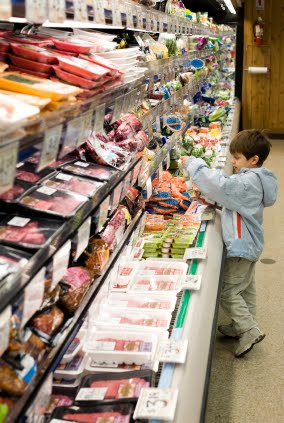
Supermarket Scavenger Hunt

By Julia Mohamed

The next time you go grocery shopping, make it a more educational, enjoyable and literate experience for your kids with a Supermarket Scavenger Hunt!

1. Give each child a list of items to gather. Be as specific as possible (include a brand name, size, etc.) For instance, you might put:
□ One 18 oz jar of Kraft Crunchy peanut butter,
□ Three small green zucchinis,
□ One loaf of Dempsters 100% whole wheat bread.

It helps if your list is divided into categories, such as produce, meat, canned foods and, of course, snacks. That way, the kids will be in one specific area of the store at a time and you can keep an eye on them more easily.

For older children, throw in a few challenging items, such as ethnic foods. For instance, One jar of Red Shell Teriyaki sauce.

2. As each child brings you items, check to make sure they’ve picked out the right ones. If not, send your troops back out into the field.

3. Reward your kids with a healthy treat!

You can continue this activity when you get home. Include them when you’re making dinner by asking them to read out the ingredients in your recipe to you.

You're going to have to go grocery shopping anyway, and you know it's always a hassle. This great game is fun, it gives the kids a bit of freedom, and it gets them reading. A win-win! (Just do keep your eye on them, eh? I don't want to be getting any letters from parents saying their kids were lost for days in the zucchini aisle...)

Julia Mohamed is a freelance journalist. Photo: Wikimedia Commons.

Tuesday, July 20, 2010

License Plate Game

Our family recently took an 11-hour car trip.

And guess what we did in the car? Played Julia's License Plate Game.

It was great! First of all, it took our son away from his DS video game (curse you, Pokemon!).

Secondly, it did exactly what Julia said it would - it got us creating goofy sentences and thinking about words. When you have to create a phrase with the letters "FTP" you realize there are so many possibilites.

It's funny, but the first phrase you create sticks in your mind, like "Frogs top poles" and you can't think of any word for the letter F other than frogs.

But then someone else comes up with a completely different word for F. My husband said, "For the people." And that created all kinds of new possibilities for us. Then we started on a bunch of "For the" sentences and that was really funny. "For the penguins." And then we morphed that one: "Free the people."

"Free the penguins!" (I just thought of that last one.)

Heehee. Fun game.

And no, incidentally, none of us ever thought of "that" F word. For pete's sake, people.
Photo: Sean Mack, Wikimedia Commons.

Thursday, July 15, 2010

Survey for research on "enhanced books"


GKR readers, the U of C needs our help.

The University of Connecticut is doing a study on illustrated children's books. They'd like GKR readers to help by taking a brief (four-minute) online survey.

Before passing along their request to you, I called them and spoke to them about their research. It sounds pretty interesting.

It's an academic study - not funded by any toy company or book publisher. They're interested in investigating a product that would enhance an illustrated book with online information. So for instance, it might be that a child clicks on a picture of a dolphin and gets some facts about dolphins. Or maybe the child is instructed to click on all of the nouns on a page and the device counts the number of nouns the child successfully finds.

The survey is intended for parents of children 8 and under, but if you've got an older child and can simply cast your mind back to the time when they were 8, they'd like your input too.

I've asked them to share with us the results of their survey so we can blog about it. The results should ready in August.

Here's the survey:
http://www.zoomerang.com/Survey/WEB22ATY56VF98

Canadian (and other non-US) GKRers - when you come to the question "What state do you live in?" resist the temptation to type "state of bliss" and just leave it blank. Their research includes Canadians and non-Americans, but not to the extent where they'll actually let you select a province. Whatevah.

Friday, July 9, 2010

Literacy games for in the car

By Julia Mohamed

Going on a road trip? Here are some great literacy games you can play in the car.

THE LICENSE PLATE GAME
● One person begins by spotting a license plate and announcing the letters (not the numbers) on it.

● Everyone else, in turn, must come up with a funny phrase using the letters of the license plate, in order. So for example, KES could become “kiss every squirrel” or “knights eating steak.”

ROAD-TRIP SCAVENGER HUNT
● Create a list of things to look for while you’re on the road.

● Your list can be adjusted, depending on where you’re travelling. For instance, a city scavenger hunt list may have: a flashing red light, someone talking on a cell phone, and a sign in a foreign language. A rural scavenger list could include: a horse, a tractor, road kill, a silo, a pond, and a gas station.

TRAVEL JOURNAL
● Before the trip, buy a note pad and box of crayons for each child in the car.

● Every day on your vacation, or for each memorable event that occurs, have the kids draw a picture and write about it in their travel journal.

● Give them some suggestions to get them started (“how about drawing the beach we were on this morning”) but after that, let their imaginations run wild. Encourage them to use as many words as possible. They may want to do the art in the evening in the hotel room or campground, and add the words in the car while you’re driving to your next destination. Young children can write one or two words (“Beach” or “Playing frisbee”) while older kids can write descriptions and even leave out the pictures altogether.

Julia Mohamed is a freelance journalist. This was her first assignment for GKR and I'm hoping it will be the first of many articles from her. (Hint, hint Julia.)
Photo: Ian Britton, FreeFoto.com.
Car literacy games? Literacy games in the car? Not quite right. Literacy games for in the car? Looks weird - sounds ok. It's what you'd say but it looks wrong when you see it spelled out. I dunno - today's not a good headline day for me obviously. Sorry, Julia. Harumph.

Tuesday, July 6, 2010

The "Air Mail" game

My son’s friend likes to play “air mail” whenever he comes over on a playdate.

It’s a great game and I know that it works on their literacy skills because I've seen improvements. It involves a bit of the adult’s time, but it’s such a fun game that I indulge them whenever they ask me to play.

Here’s the game:
The kids run upstairs and hole up in their bedroom.
They each, or together, write a note to me on a piece of construction paper.
Then they run downstairs and throw the note in my general direction – and then run giggling, like criminals, back upstairs where they slam the bedroom door.

So we’ve got lots of good elements here. There’s some kind of “chase” which involves getting the note to the adult without being seen. The adult can add to the excitement by either pretending not to see the note, or suddenly flinching in the child’s direction as through he’s going to chase them.

The first note from the children will be something like:
“We want a snack!” or “Ask us a question!”

Then the adult writes a note on the other side of the paper. I usually try to get some kind of dialogue happening, like: “Ask the Oracle a mysterious question.” Last time, I tied two snack bags of jelly candy onto the note and then pitched it at their bedroom door where it made a very satisfying – and disconcerting – thump. That was the kids’ cue to gingerly open the door to see if I was still there (I wasn’t) and retrieve my note.

If you can picture it, there is a lot of silliness, giggling, whispering between the kids and slamming of doors. There’s a lot of running up and down the stairs and a lot of suspense about what the note will say, whether they’ll get caught sending or retrieving their notes and whether they’ll get a treat.

In the meantime of course, there’s reading and writing. And I don’t make it easy for them. I use big words and I make sure there’s a pay-off for reading and understanding each message.

For instance, in our most recent game “Ask the Oracle,” the kids’ second note didn’t include a question. I figured they probably didn’t know what an Oracle was. So my next note told them to look the word up in the dictionary to find out what an Oracle could do for them. There was a pay-off to using the dictionary (because Oracles are cool).

Sometimes I make my notes into paper airplanes and throw them at the bedroom door. Sometimes I load them with a treat or even carrot sticks. Usually there’s a payoff for them writing another note back to me—maybe it’s a knock-knock joke they’ll have to ask for the answer to. Or sometimes it’s a nugget of information that they have to ask for more details about. Just something to keep the game going and keep the kids reading and writing. And giggling.

Photo: Wikimedia Commons, by Akkana.

Thursday, April 29, 2010

Physical literacy games

It's a good idea to link learning to physical activity.

I was inspired this week by my son's teacher, who was teaching them fractions by having them throw balls into various buckets marked 1/7, 1/3, 1/4, etc. They had to add them up and avoid making an improper fraction.

I think that's great. Because they're doing something physical, their thinking will be linked to muscle activity - not to mention being outdoors - and it will all sink in so much more easily. The learning will stick with them longer, too.

It got me thinking about physical games we could play with kids around words.

The buckets could be labelled with letters (E, I, A, L, S, M) and the kids could throw balls into the buckets to gather letters which they could use to make words. If they miss a bucket, they can't use that letter.

Or, the game could be about vowels. You have to try to only get your ball into the vowel buckets, and avoid the consonants. You get a point for every vowel you hit. Or you then make words that have those vowels in them.

Or, you could label the buckets with words, and try to form sentences.

Matching physical, outdoor activities will help most kids achieve better results. For certain kids, it may be the only way they can learn.

Wednesday, April 7, 2010

Great online game: Clockwords

Clockwords is an online word game I can't stop playing. (Must. Stop. Playing... Have. Deadlines...)

Here's why it might be good for your child - in moderation, something I'm not particularly good at, so be forewarned.

1) Literacy
The game is based on you (uh, your child, that is) coming up with words, lots of words. But not just any words. You do much better in the game when you come up with words that are long and use "difficult letters" like J and Q rather than, say, vowels. Plus, you get more points if you don't repeat the same words and if you enter a string of words the same length. So it gets you thinking about vocabulary. And spelling is very important because the game won't accept a word that's spelled incorrectly.

2) Typing
You have to type in all of the words, of course. And the faster and more accurately you can type, the better you'll do. I'm a big advocate of kids learning to type, because it helps them get their ideas down faster when they're writing something and it may be an incentive for technology-oriented kids to write.

A synopsis of the game
Like most games, the plotline is a bit fuzzy. Something about a clock-machine and some robot bugs that are eating its documents? Does that sound right? No it doesn't, but stay with me.

You type words into the machine, preferably using the letters that appear on the screen in tubes. Those words are loaded into some kind of blaster and are shot at the bugs. The more letters in the words you choose, the more ammunition to blast those bugs. You win a round by blasting all the bugs so they don't - erm, eat your document? Or something.

Did I mention this is a really good game? Trust me, it is.

At the end of each round you can "buy" letters that have qualities like freezing ability or... OK, I'm going to stop here. It's sounding a lot more complicated than it is.

Just play it.

Thanks to Barte Bonte for pointing out this addictive game. Now, could you please call my publishers and explain why I'm about to miss my deadlines? Thanks.

Wednesday, March 10, 2010

Get your video-kid reading

Kids can be into video games and enjoy reading, too!

Your child loves video games but isn't a big reader? No problem. Here are some tips that will get your video-loving kid reading.

1) GO WITH THE FLOW. Studies show that kids are more apt to read things that interest them.

If video games are a huge interest for your child, try to work with that:
*Subscribe to a gaming magazine. There are tons of them, and they contain what gamers crave-tips to help them unlock secrets in their favourite games.

*Suggest gaming websites that have a lot of written instructions, or which require the player to type instructions in order to progress in the game. For instance, Dungeon Scroll is a new kind of hybrid game combining a word game with a RPG (role-playing game).

*Kids who like video games may also like comics and graphic novels. At websites like Make Beliefs Comix they can create their own comics online.

*There are some cool online literacy and math games at Bite-Size Literacy.

2) THINK LIKE A GAMER. If your child has a Nintendo DS, get him to use the PICTOCHAT function to type messages back and forth with his friends. From the DS's main screen, click on PICTOCHAT. It will bring up a screen and a mini keyboard your child can use to type messages.
How about PICTOCHAT Hide-and-Seek? Have one child hide and have his friend type messages via PICTOCHAT with clues to find him. (This game was developed by an eight-year-old boy who loves video games.)

3) GET HIM TYPING. It's a skill he needs for gaming anyway, and it will develop his literacy skills. Once kids can type, getting them to write stories and essays will be much easier since they'll be able to get their thoughts down as fast as their brain can come up with them.

Make sure the typing program you choose is QWERTY-based so they'll learn to use the Home Row. An excellent one (that worked for my child) is Dance Mat Typing, by the BBC.

4) SUGGEST ONLINE GAMES that include a literacy component. For instance, at Club Penguin, kids control a virtual "penguin" who plays games and can chat with other "penguins." In the Club Penguin book room there's a great typing game where the penguins can type a virtual book to earn all-important Club Penguin dollars.

5) GET YOUR CHILD BOOKS WITH SHORT BLOCKS OF TYPE AND LOTS OF IMAGES. Boys in particular like books with facts, lots of visuals and chunks of text.

Here are some suggestions:
*The Encyclopedia of Immaturity by Klutz.
*Guinness World Records
*Books on magic or featuring science experiments

6) CONSIDER V-BOOKS. This is a brand new genre in publishing, and it may be appealing to kids who like gaming. Kids read the book, and every few chapters there's an instruction from the writer to go to a website and input a password that lets the child see a video. The video supports the book in some way and furthers the plot. The v-books that are currently available (Skeleton Creek, by Patrick Carman, for instance) are too scary for most kids. However, he recently released Trackers, which is apparently less scary (although it's still pretty intense, from what I've seen). In any case, this is just the tip of the iceburg. This is clearly a new realm in publishing for kids and young adults, and within a very short time we're going to see an explosion in the number of books that cross the boundary between paper and technology. To check out Skeleton Creek and Trackers, visit the author's website. For a book series with a different type of online accompaniment, read The 39 Clues, by Peter Lerangis. Kids can go online (http://www.the39clues.com/) to track down clues and enter a contest to win prizes.

7) SET SOME BOUNDARIES. There's no getting around it--you will have to set "screen-time" limits. Kids can't read if they're gaming all the time. How much will depend on your child, but some parents say no gaming during the week, and then two hours of screen-time a day on weekends.

This post is part of the Literacy Blog Tour (March 8-14, 2010) - welcome tourists! We hope you'll be back again and again.

Monday, March 8, 2010

Getting active kids reading

Sitting and reading is not the only way.

At age five, girls are able to sit still and listen about 2.5 times longer than boys, according to studies.

But we don’t need research to tell us that most boys would rather get up and move around than sit and read.

Here are some great ways to keep active kids happy while they’re learning. (Statistically, this tends to be a boy issue--so we're using the male pronoun--but if you’ve got an active girl these tips will apply just as well.)

1) LET HIM MOVE. Let your son play with a ball while you read to him. Having a ball to quietly hold and catch helps lots of kids concentrate better.

2) INTERRUPT THE STORY. When you come to a plot point, stop and ask him, “why do you think that happened?” or “what do you think that meant?” Not only does it help with comprehension, but it breaks up the monotony of listening.

3) GO OUTSIDE. It's called "environmental literacy" - finding things to read outside. There are tons of signs and advertisements to read out there, and even word puzzles to figure out. What does that parking sign mean? When can you park here? How much is parking? What is that an ad for? Do you believe the ad? He’ll have to read carefully to figure out the answers.

4) MAKE EVERYTHING A CONTEST. Active kids, and especially kids who like sports, love to be timed, challenged, and rewarded. When you play literacy games, getting out a stopwatch can bring the right measure of fun competition to it.

5) PLAY ACTIVE GAMES. Take a long strip of paper – say four feet long by four inches high (or several strips). In marker, write a sentence on it. Then cut the sentence up into words. Hide the words around your backyard or playground. Have the child run around and collect the words, bringing each one back to you when it’s found, before running out and getting the next one. When he has them all, he can piece them all into a sentence. Time him and see if he can do it faster the second time around.

6) HOST A TREASURE HUNT. Use signs to lead your child up to his bedroom, across to his dresser, over to the bathroom, down to the basement, into a closet, up to the attic, into the fridge… and then over to the dining room table, where he’ll find his treat (chocolate, or a wrapped book, or some other small reward). It’s a great game that combines reading with physical activity.

7) WRITE A STORY WHILE YOU’RE WALKING. Schedule a long walk, just the two of you. While you’re walking, lead him to create a story – with characters, an interesting setting and a couple of plot points.

Extending this activity: When you get back home, he can dictate the story so you can write it down, or he can type it up. Make it into a book and add illustrations. He’ll have something tangible that he has created.

This post is part of the Literacy Blog Tour (March 8-14, 2010) - welcome tourists! We hope you'll be back again and again.

Tuesday, March 2, 2010

Fishy literacy game

A do-it-yourself game that helps early readers connect capital letters with their lowercase equivalents. Thank you to guest blogger Dawn Little, for this post.

Here is a fun letter match game to help your child recognize and match capital letters to lower case letters.

1. Gather your materials: One small magnet, a wooden dowel, yarn, glue, construction paper, markers, scissors, and 52 paper clips (and 26 googly eyes, if you'd like).

2. Make a fish template on a piece of construction paper. Use the template to cut out 52 fish (26 capital letters, 26 lower case letters). Give your fish smiles and either make an eye using marker or glue a googly eye on each one. Attach paper clips to the mouth of each fish, like a fish hook.

3. Make a fishing pole by tying a piece of yarn to one end of the dowel. Put glue on one side of the magnet and attach it to the hanging end of the yarn.

4. Scatter the fish on a table or the floor. Give your child the fishing pole and call out letters, calling out a capital letter first. After your child catches that fish, call out the lower case letter match. Ask her to match the lower case letter with the capital letter.

It's a good idea to use only half the alphabet at a time; for instance, A through I. Do J through K next time; you don’t want to overwhelm your child. Plus, if you only do half the alphabet, you’ve separated out the tricky b/d and p/q, which can be confusing for kids.

I adapted this game from the School of Fish Game at No Time for Flashcards.

Have fun fishing!

Dawn Little (aka Links to Literacy on Twitter) blogs at Teaching With Picture Books, providing educators with picture book lessons based on comprehension strategies and the Six Traits of Writing. She also blogs at The Literacy Toolbox, where she provides educators and parents with tips and tools to enhance the literacy lives of children. She is the founder and owner of Links to Literacy, a company dedicated to providing interactive literacy experiences for children and families.

Did you spot those cute little Dawn's-daughter's-toes in the bottom left of the photo? Cute little fisher-girl.

Friday, February 26, 2010

Dry-Erase Crayons

Things that make you go "d'uh!"

This is one of those inventions that you wish you'd thought of.

Dry-erase crayons
. How good is that?

No mess, no smell, no drying out. But do they work? This is the best part - they really, really do work well.

The colours are deep and rich, and they write smoothly. Kind of like a cross between crayons and lipstick. Even on paper, which I don't advise because they smudge, they are vibrant and smooth-writing.

Combine this product with the idea about using a plastic plate as a mini-whiteboard, and you've got yourself a fun literacy-building activity. That wipes right off.

The dry-erase crayons come in packs of eight, with an "E-Z Erase Mitt" (in Canada it's an E-Zed Erase Mitt, which makes no sense but still wipes off just fine) and a built-in crayon sharpener.

I bet it won't take long before you're seeing them in classrooms and boardrooms. Fun! Crayola's selling them here for $5.48 a pack. Incidentally, I just Googled "dry-erase crayons" and found out that Sargent also makes them.

Sorry if this article sounds like a commercial for Crayola. I'm not affiliated with them, I don't get money from them - heck, I didn't even get a free box of crayons, just two sample crayons (which everyone at the For the Love of Reading conference also got). I just happen to like this product. Still, the article is a bit gushy. I will try to curb my enthusiasm just a titch in future.

Thursday, February 18, 2010

Plastic plate as whiteboard

Here's another great idea from Lori Jamison's workshop.

A cheap, plastic plate can be used as a mini-whiteboard for kids.

They're durable, easy to store and inexpensive.
And best of all, dry erase marker wipes right off!
Kids can practise their writing on them, wipe off what they've done, and then practise again.

Jamison suggests you give each child a little glove (raid the lost-and-found, she says), which they can use to wipe their mini-whiteboard clean.

She packages a plate, marker and glove in a Ziploc bag for each child.

One caution - she says that not all plastic plates are erasable. And she says you should never, ever bring a marker to a store, poke a hole in the packaging, and try the plate before you buy it. No, no.

Friday, February 12, 2010

Finger Puppet Book Bags

A little gem from the literacy conference.

It's a knitted book bag, with finger puppets that adhere with snaps to the bag. A knitted string lets the child hang it around her neck and take it anywhere.

Each bag has a theme. For instance, the Ocean bag has a handpainted ocean scene, and it comes with a clownfish, a crab, a mermaid, an octopus, a sea turtle, a seal, a shark and a starfish.

The idea is that you put a book, or a couple of books, into the bag.
There's a list of book suggestions for each bag. For the Ocean bag, they suggest Baby Beluga, by Raffi and Commotion in the Ocean, by Giles Andreae (and eight others).

Then, wherever your little reader goes, she carries an entire puppet show with her.

Interacting with literature is definitely a great way to get kids reading.

The bags are made in Bolivia by indigenous peoples; it's a Fair Trade project, benefitting both countries and helping families in Bolivia earn a living wage.

You can purchase a bag, a product the owner calls 3 Bags Full, from her website.

And speaking of the owner - here she is. Her name is Sue Berlove, and boy, she is passionate about what she does. Do visit her website. For one thing, they have way better pictures of her bags than the one I've used here (taken myself, as if you didn't know.)

Friday, January 22, 2010

Mysterious Benedict logic puzzles

If your child loves puzzles, click here.

I've been raving about The Mysterious Benedict Society books.
My son is loving them and frankly, so am I.

They're about four unusual children who are called upon by Mr. Benedict to solve a threatening, decidedly adult problem. The impending utter breakdown of society by an evildoer, to be specific.

The books are great because they're focussed on the children, and their very diverse and unique gifts. Each of the children is brilliant in his or her own way, and each is a bit of a misfit. Working together, they pool their gifts to solve mysteries and save the world.

The reader gets in on the fun, since many of the puzzles faced by the children are posed in such a way that the reader of the book can attempt to figure them out as well.

A great website
The website that accompanies the book has a series of logic puzzles, like the ones found in the book. In one instance, you'll face four doors, each with a number and a letter. You have to figure out which one to open. (And I love that the instruction isn't, "which door doesn't belong?" it's "which door should you open?")

Kids have to figure out for themselves that on one of the doors, the number of letters matches the number. For instance six-3 would be the answer since "six" has 3 letters.

There is a whole series of delightful puzzles that should prove fun for kids who enjoy thinking things through, and get a kick out of getting the answer right.

Try the website for yourself - the great thing about these books, and the website, is that the puzzles are intended for kids but could easily stump an adult. The other great thing is that hints are provided, so if your child is stuck she can click on up to five solid hints that should lead her logically to the answer.

Photo: This is a picture of the author, Trenton Lee Stewart. I snagged it from Publishersweekly.com, but since it's also the one featured on the book's website I figured it was probably an officially sanctioned photo so I won't get sued.